5/28/04
Cozzene's Angel was checked in foal to Pulpit this morning. We are very excited especially after watching Purge win the Peter Pan G2 last weekend.
5/28/04
Nice Story.
Sometimes things just fall into place and happen like they were scripted. Smarty Jones is a great story. Doesn't it seem like the "best story" usually wins the Derby? Wouldn't it be great if this time we have a Triple Crown winner as well?!
We have a nice story here on our farm too, but it started out with tragedy. Our good friends Jeff and Doris Harwood had a foal named Julia Rose that broke her leg as baby. They decided to save the foal to be a broodmare even though it was not financially wise. There was a lot of sentiment and emotion behind their decision because the foal was named after Doris's sister who had just passed away. Julia Rose healed, grew up and eventually became a mother.
Her first foal, now a three year old, was named Tiffany Rose, her second foal was a filly named What A Talent.
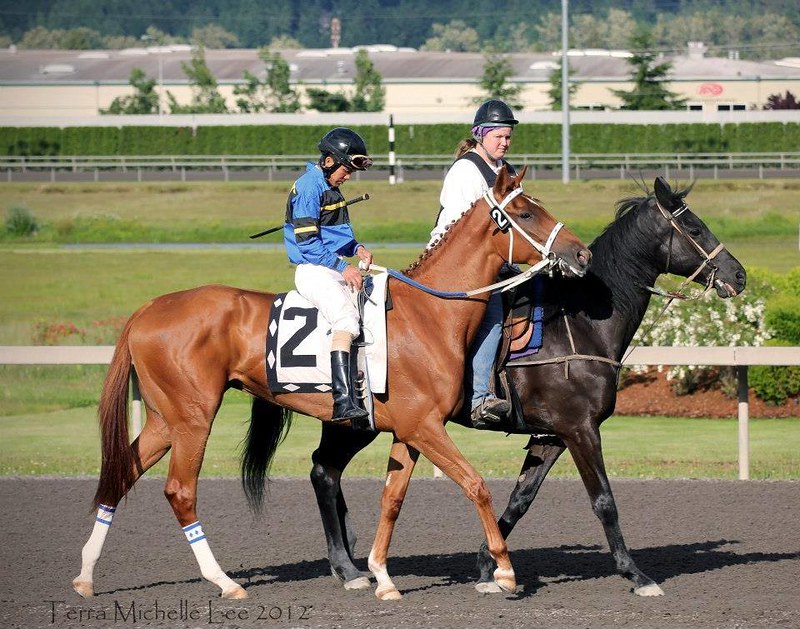
Last week at Emerald Downs, both fillies won their first lifetime starts. What a great reward for the Harwoods, and let's hope that this is just the beginning of another great story.
5/28/04
Speaking of great stories, there will be an article coming out in the Blood-Horse next week on George Krikorian. He purchased our yearling colt out of Cozzene's Angel by Out of Place last fall and named him Hockey Fan.
Mr. Krikorian races in southern California, loves the game, and is a great guy. We are very pleased that he has our colt.
MAGNESIUM OVERDOSE - Update #4 5/14/04
The following is a reply from Amy Gill, who holds a Ph.D. in equine nutrition and writes for the TB Times.
Mary Lou,
Sorry to hear of the mix-up. I hope it was 6% in the premix and not the finished load as this would be a much lower inclusion rate. Regardless, as you know, magnesium is a potent laxative and hence the diarrhea. It is not stored in the body so once cleared, blood levels should return to normal. Calcium absorption can be affected with high Mg levels, so you may want to have the vet pull blood on a few to see if they are low. Feeding some good quality alfalfa hay would be in order now. Keep up the probiotics, gastro guard and Pepto Bismol would be good. I doubt there will be long term effects - once it's over it should be over. Good luck and holler if you need more help, but please let me know the outcome regardless.
Original message:
Dear Dr. Gill,
We had an incident with our last load of bulk grain that I thought you might be able to help with. The mill accidentally put too much Mg (6%) in 3T load and as a result, all of the horses (46) on the farm had diarrhea. I have not seen their report yet, so I don’t know it the 6% was of the total load or 6% of the premix. Their representative said it was of the total load, but I can’t believe that is correct.
My worry is that we may have problems in the future as a result of this. We have about 20 mares that are between “just bred” and 4 mos. in foal. We also have 2 sucklings that are still “not right” since they had diarrhea. We have been treating with Probios and Gastro-Guard. They are currently nursing, but occasionally go “off-suck”. We had two colic episodes, one in a yearling and one in a mare while they had diarrhea. One mare still is “loose”, but the other horses appear to be normal at this time.
Do you know of any possible problems that Mg could cause in these mares?
Do you know of anyone that we might contact regarding Mg overdose?
Sincerely,
Mary Lou Griffin, owner Griffin Place
OUTBREAK OF DIARRHEA - Update #3 5/10/04
Mary Lou talked to Dr. Patricia Tallcott at WSU today. She has never seen an overdose of magnesium in horses, but she did see it in cattle one time and that is why she had advised Mr. Evans from the WA Dept of Ag to test for it. She said that the mg they don’t need is usually excreted. I am still trying to talk to a few people in KY and will let you know what they say.
Things are settling down here. One mare and one foal are still not 100%, but everything else looks good.
OUTBREAK OF DIARRHEA - Update #2 5/7/04
The following was a letter from Mary Lou to Griffin Place clients:
Our feed company notified me today that the grain we suspected was, in fact, not right. It contained a high level of magnesium. We will be consulting with WSU and possibly some nutritionists in KY on Monday to see what if any problems other than diarrhea are associated with magnesium overdose.
Again, we will certainly pass along any information we receive.
So far, most of the horses appear to be back to normal. We have seen weight loss in the yearlings and particularly in the nursing mares. In two cases, it was quite severe. One mare and one yearling had colic symptoms, and some of the foals have been slow to recover. One foal was sent to the clinic because we could not get the diarrhea stopped, and it was starting to show symptoms of colic.
I have contacted you if your horse is anything but normal.
We are still treating all horses with Probios and some with Gastro-Guard.
Again, feel free to call if you have any questions or concerns.
Sincerely,
Mary Lou
OUTBREAK OF DIARRHEA - Update #1 5/7/04
All the horses on the farm appear to be over the diarrhea.
As soon as we saw that we had a problem, we discontinued grain and alfalfa hay. Yesterday, we started to feed grain again to all but the barren/maiden mares. We will use them as a control group in case there is a reoccurrence. We have also started to feed alfalfa again to everyone.
We expect results from the testing sometime next week, but realistically, we may not see anything definitive. In the mean time, we continue to consult with our feed mill, with Mr. Evan Evans of the USDA and of course with our veterinarian, Dr. John Procter.
OUTBREAK OF DIARRHEA - 5/5/04
The following was a letter from Mary Lou to Griffin Place clients:
We have had an outbreak of diarrhea involving most of the horses on our farm this week. Most have not appeared sick and in fact appear to be normal now. (If your horse is anything other than normal, I have called you.) At this point, we don't know what caused it, but we are being proactive. One possible cause may be a "bad" load of grain. We have contacted the feed mill, and they have removed the feed brought a new load, and taken samples for testing. We have also hired an independent feed company to test samples. In addition, Dr. Procter contacted the USDA to help us find the cause of our problem. Their representative came to the farm yesterday and took samples of the grain and hay to test, and they are consulting with an epidemiologist at WSU, just in case it is disease related.
We have treated all the horses with Probios, and in some cases we have also given Gastro-Guard.
We will be happy to answer any questions as best we can and to update you, so please feel free to call.
We will let you know the results of the tests as soon as we get them.
Sincerely,
Mary Lou Griffin
NEONATAL ISOERYTHROLYSIS (NI) - 2/14/04
This is something you don't ever want to see. One of the things that happens as we grow, and as the years go by, is that we see things happen that are rare. It's just that sooner or later because of the numbers, we run into them. NI foals are rare, but we had one. So, the first thing we did was gather all the information on the subject that we could.
What we learned was that the condition is caused by the foal inheriting a blood type from its sire that is incompatible with the dam's corresponding blood type. The mare then produces antibodies against the foal's sire-related blood factors and they are passed on to the foal through the colostrum. The antibodies then enter the foal's blood, where they recognize, combine with, and destroy the foal's red blood cells. After a few hours to a few days, the foal becomes jaundiced, has an increased respiratory rate and elevated pulse. It is often fatal.
So, on the practical side, we learned that we will have to run a blood test on this mare a couple of weeks before foaling to determine if this will happen again. If so, we will have to muzzle her foal, and give it donor colostrum. Then, we will have to keep milking the mare out for about 36 hours until all of her antibodies are gone, at which point we can let the baby nurse normally.
We contacted the University of California Davis and asked a few practical questions and they very nicely send back prompt answers.
What about testing the mare's milk with a colostrometer and when it was a .04, which is "milk", could we put the baby back on? No, we must wait 24-36 hours, because even milk will have some antibodies in it.
What about transfusing the foal with the stallion's blood? The stallion is actually the WORST donor, because the mare's antibodies are directed against his red cells. It would worsen the NI. The best donor is actually WASHED red cells from the mare.
Will all of the mare's future foals be NI? Only if they have the blood group the mare's antibodies are directed against. To know this, you must have the mare blood typed and checked for antibodies. For more information see http://www.thehorse.com/ViewArticle.asp?fid=70 Note: You may need to sign up for your free subscription in order to read the article.
Dr. Procter has only seen 4 NI foals in his 29 years of practice. Even though we sent this one to the clinic right away, they could not save it. Everyone feels bad.
A day in February - 2/10/04
Our sixth foal of the year was born tonight. A nice big colt. It’s been a long day. First there was feeding and teasing. We are short one employee this week so the regular work takes longer. The veterinarian arrived at 8:30 AM to do a new foal check on Holly nurse mare’s foal. He also did a Coggins Test on a mare that is scheduled to ship to KY in two weeks. We vanned a mare to Enumclaw to breed to Liberty Gold at 1:00 for the first cover of the year, stopped at the feed store to get more soy pellets and headed home again to bring in horses. Holly was in mild distress when we went out to get her. The baby was fine. We treated her with pain killer, but after an hour, she was still colicky. We called the vet who came out and gave her mineral oil through a stomach tube. At 9:00 another mare foaled and at the same time, Holly started to get colicky again. The foaling was normal and fast. Holly seemed comfortable after more medication. Maybe now we can all get some sleep.
A day in February - 2/11/04
Holly has been getting worse. The veterinarian came out again at 7:00 to give her more mineral oil and more medication. She got better and then got worse again about 1:00. We gave her more pain killer but it wasn’t keeping her comfortable so Dr. Procter came back at 6:00 to give her electrolytes via stomach tube. Holly is not eating or drinking. He suspects it is a perforation somewhere in her gut. There is not much we can do except keep her comfortable. Surgery will not correct this. Another possibility is that it is a slow bleed internally. If this is the case she may pull through if we can keep her quiet. The baby is fine, but we have lined up a nurse mare just in case. This is not fun.
A day in February - 2/12/04
It’s just after midnight, and it seems the day is never ending. The “copy cat” just brought a dead mouse into the office. What a nice present….... But hey, Holly just rallied so who cares. Holly is not doing well, but she did get up and let the baby nurse. We will keep supporting her with pain killer as long as she has a chance, and we think she’s not suffering. Life on the farm can be a challenge.
7:00 AM. Veterinarian is back to examine Holly. We think we were wrong. There was gas trapped under the skin all along her back and sides which is consistent with a ruptured diaphragm. It was very strange to feel and I hope to never do so again. She is now spiking a fever of 104.5 and we cannot keep the pain under control. The decision is made to euthanize her. This is a sad day. Everyone on the farm is fond of Holly.
Now we start the process of grafting the foal onto a nurse mare. It will be another long day and night.
7:00 PM. We were able to find a nurse mare. Her name is Fantazia and she is an Arabian who had a deformed foal that had to be euthanized. We have had her in our nurse mare “gate” since this morning, but until now, we have had to hold her as well so she would let the baby nurse. As of now, she is willing to let it nurse without us. Bed….finally.
A day in February - 2/13/04
5:00 after watching the nurse mare and baby periodically through the night, we are ecstatic to hear a knicker from the mare. She is going to take this baby and we can turn them loose together. What a welcome sight. What a nice mare! A happy ending.
1/11/04
It’s time to get ready for the arrival of new foals. This means
among other things, checking our cameras, our foaling kits, and our
colostrum supply. Colostrum is always in short supply, so we would
like to talk about it a bit, and encourage everyone who can, to
collect and save it.
What is colostrum and why do we need it?
Colostrum is the first milk that a mare produces. It has high levels
of immunoglobulin that are important for the foal’s immunity. We do
two things to insure that our foals get adequate colostrum. First,
we immunize the mares one month prior to foaling so that their
antibodies are passed on to the foal through the colostrum. Second,
we test the colostrum of each mare immediately after she foals to
make sure the colostrum is of good quality. If it is not, we give
the foal donor colostrum from another mare.
Why would a mare not have good colostrum?
-
A mare might drip or run milk prior to foaling, and lose part of
or all of her colostrum.
-
A mare occasionally will not produce colostrum with an acceptable
level of IgG.
-
In rare cases, mares produce antibodies against their foals’ red
blood cells. These antibodies are concentrated in the colostrum. If
a foal is allowed to ingest this colostrum, neonatal isoerythrolysis
(NI) or jaundice may develop in the foal.
Unfortunately, in the worst case, a mare dies, and then the foal
must get all of it’s colostrum from a donor.
We encourage all farms to collect colostrum and store it, even if
they are only foaling one mare. If they don’t use it, they can
always donate it for use to someone else. Here in Washington, we
have an informal network for obtaining nurse mares and for sharing
colostrum. The WTBA (253) 288-7878 has information on who to
contact.
How much colostrum does a foal need?
You should consult with you veterinarian about this, but most agree
that 1 pint of “good” colostrum is enough.
How do you know if colostrum is good?
We test ours with a colostrometer. Consult you veterinarian to
discuss what’s best for you.
How do you collect and store colostrum?
Immediately after foaling, we collect from 4-8 oz from most mares.
We test the colostrum with a colostrometer and if it is “good” we
put it in a double bag for freezer storage. It is important to
identify the package with the name of the mare (so you know if this
colostrum is from an immunized mare), the date, the quantity, and
the quality of the collection. As soon as this is done, it should be
put it into a freezer. (Note: When unthawing it, DO NOT put in
microwave. That will kill all of the antibodies.) We don’t know how
long it is good, but rule of thumb is not to use colostrum that is
over one year old.
The alternative to giving colostrum is to transfuse the foal with
hyper immune plasma. We prefer to avoid that if we can because it is
expensive and stressful for the handler and for the foal.
So, with that said, we hope we have convinced a few more people to
start collecting and storing that valuable colostrum to use for the
foals that really need it.
|
|