|
|
| Mary
Lou and Lady Rebecca Purves at Happy Valley Racetrack in
Hong Kong
|
Lady Rebecca Purves is now a co-owner of
Shek O Prospect shown here as a yearling
|
10/21/01
Kindergarten Class is still in progress. However, due to some
unanticipated construction by others, we can't get a trailer in so,
that part will wait a bit. More to follow.
10/20/01
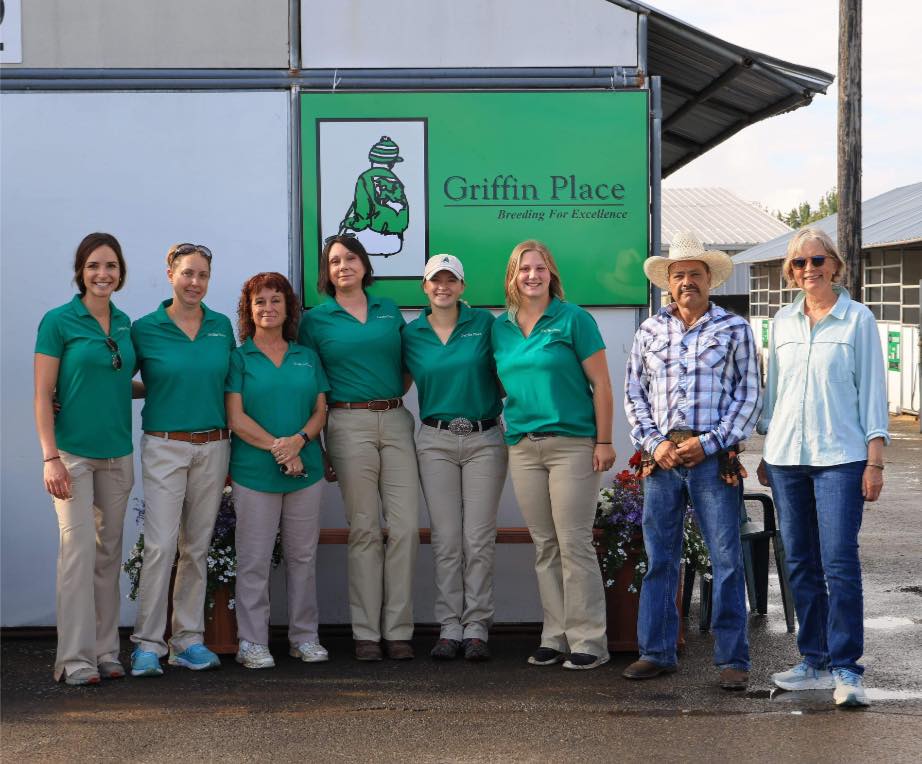
Griffin Place Summer Sales Crew

Left to right: Jose Jacobo, Terry Griffin, Daina Bell, Jayne
Arnold, Melissa Lucas, Lanny Fairbanks, Sam Ellis, Mary Lou Griffin,
Victor Avila-Ramos,Becky Goad, Devin Griffin, Megan McBride & Venessa
Koehn
10/18/01
I've sold two mares, part of improving the band, but off course
Where's Will out of Noname Justfame won his race. But I've sold Noname
and No Lost Action. I'm going to Keeneland and see how the sales go.
10/17/01
Yesterday was one of those terrible days only "horsepeople" could
understand. Doris said that both Shek O and Campanita are sick.
Campanita may need to go to the clinic (hospital in layman's terms).
Bold Magestrate aborted her Pine Bluff foal. We found her in the field
with the fetus. Of course we did an autopsy and sent in tissue samples
but there was nothing abnormal looking. I can't help but wonder if it
has something to do with the KY mare syndrome. We may never know.
Today is a little better. Doris called and said that Campanita is
much better and Shek O is wild. However, now I have the flu.......
So it goes.
10/09/01
The "Kindergarten Class" has begun.
Each fall, after all the foals are weaned, we put them through what
we call our Kindergarten Class. For about three weeks, we bring them
into the barn and work with them individually. Beginning lessons are
learning to tolerate stall confinement, learning to lead without the
"butt rope", and learning to be groomed. Then, we progress to
teaching them to go to the round pen and lounging. Here we are very
careful not to do too much circling, as we are not conditioning them,
only teaching to work without other horses around them. We also
introduce the chiffney bit, the lip chain and the twitch. The last
week we teach them to load in the trailer. When they complete the
program, we want them to enjoy being handled, to trust people, and to
be comfortable doing whatever it is we ask of them.
Graduation Day means giving them a ride in the trailer to the other
end of the farm. From then on they live outside in the yearling
pastures until it is time for them to be sales prepped or go into race
training. That doesn't mean we don't handle them. We scratch and pet
them and give them a good look twice a day when they come up for their
grain. We also bring them into the yearling barn for a few days prior
to every scheduled trimming. All in all we feel that our program
works well for us. Our foals are allowed to play and interact with
each other in a very natural way. They get the exercise they need to
develop as athletes, and they remain civilized enough to handle
safely.
9/19/01
In this time of crisis, those of us the own and raise horse can
derive great comfort from them. Remember the worlds of a past great
statesman
"There is something about the outside of a horse, that is good
for the inside of man"
7/31/01
Our American Chance filly out of Deputy Belle had to be put down
yesterday. The ankle wouldn't fuse due to a small bit of infection
which the vets at WSU couldn't resolve. We tired.
7/30/01
Our mares are all home from KY. They are both barren. Unfortunately
both Outofthebluebell and Atoyac got caught in the "Year of the
Catipillar" and they are barren. If we are lucky enough to have them
cycle in heat, we will culture them to make sure there is no
infection. Cozzene's Angel and her filly are both doing great. We are
very pleased with her Aggressive Chief filly. She is in foal to Out of
Place. Bold Magestrate was the first home and is in foal to Pine
Bluff
5/21/01
Atoyac is being re-bred and so is Cozzene's Angel. Outofthebluebell
is being worked on to clean her up and get her healthy. We won't even
try to rebred her this year...just hope she is OK.
05/16/01
It continues to get worse, Rings A Chime has lost her foal too!
But to offset the bad, Deputy Belle had a filly.
05/15/01
We all read the stories in the Blood Horse and Thoroughbred Times,
but think we are OK here in Washington, but a lot of breeders move
their horses around to various stallions as we all try to upgrade our
operations. The toxins in the grass claimed the foals that
Outofthebluebell and Atoyac were carrying. But to add to the
uncertainty and sense of wonder and mystery that surrounds our
business Cozzenes Angel had a normal filly by Aggressive Chief Friday
the 11th. Bold Magestrate is still in foal and we are shipping her
home. We've started her on "Mare Guard" the product that should bind
up the 'toxins'.
04/26/01
New Ali's Pearl Photos
04/24/01
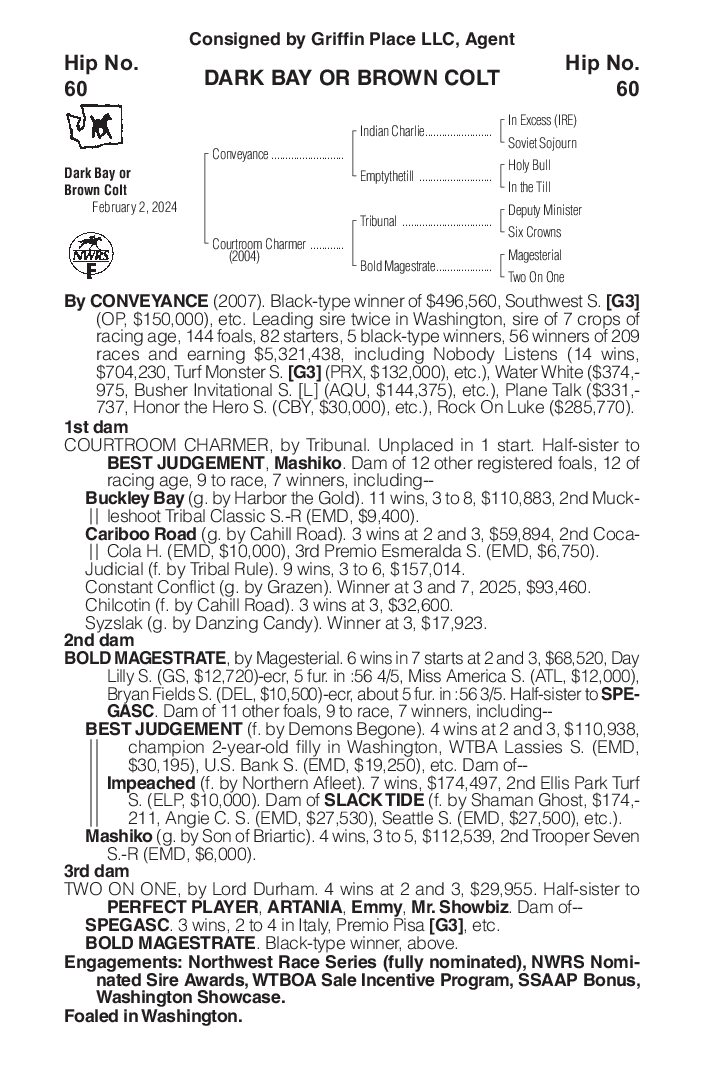
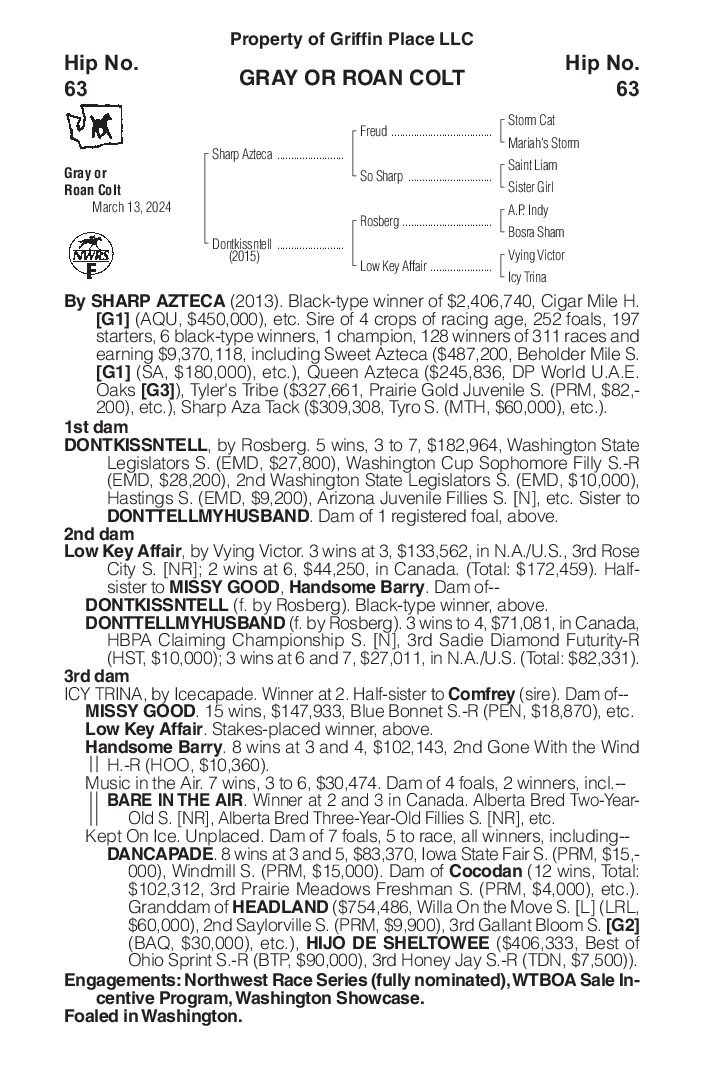
Demons Begone x Gallently Happy colt
Owners: Mr. & Mrs. Bill Standish

Cahill Road x Tempered Dawn colt

Cahill Road x Decidedly Nattilie filly at 10 days

4/22/01
A new filly out of Decidedly Natalie by Washington's Leading Sire
Cahill Road. Foaled 4/10/01.
Owners: Bear Creek Meadows, Mr & Mrs C. Arnold

3/24/01
"Leading lessons"
When I first started raising horses (back when things were still
black and white as my daughter says), I thought the best way to get a
mare and her foal from one place to another was to lead the mare and
let the foal follow. Well, I quickly found out that the foal didn't
follow. At least it didn't follow if there was something scary or
something more interesting to look at in another direction, or if it
just felt good and couldn't stand to poke along. The answer I thought
must be to have another person get behind the foal to encourage it to
follow. Well, that didn't work too well either. Better, but not
well. So, I did some reading and some talking to other breeders and
learned about the "butt rope". Very simple. The idea is to run a
lead rope around the rump of the foal and then lead it alongside mom.
So, with the foal in one hand and the mare in another one handler can
get along quite nicely. Most of the time. There are still the scary,
and the interesting, and the "can't stand to go this slow on a cold
morning" times, but mostly it works really well. Once in a while if
things really deteriorate, the handler simply lets go of mom and
settles baby down. Mom doesn't go far. I have used this system now
for 25 years and would never go back. Every once in a while someone
will compliment me on how well our foals lead and behave. This is
usually followed by "we can't lead our foals because we just have too
many. ". I smile. I can't do it any other way. It would just take
too much effort, and too many people.

Sydney "the dog" providing the leading lesson
3/23/01
"Ain't it purdy?"
When I was a student at CSU in Colorado, I had the greatest summer
job ever. I worked on a ranch in the Rockies and I was able to trail
ride up in the mountains. On one of the overnights, our neighbor and
guide took his five-year-old daughter, Sassy, along. We rode all day
and we were all tired, but toward late afternoon we got to the top of
the ridge and took in an absolutely magnificent view. We were all "ohhhhing
and awwwwing". Little Sassy took it upon herself to stand up on her
saddle so she could see even better. We all held our breaths hoping
her horse wouldn't move, but she was completely unconcerned. She just
stood there and said, "Ain't it purdy?" Couldn't have been said
better.
Today was one of those "ain't it purdy" days. Sometimes you just
have to stop and remember how lucky you are.
3/21/01
Follow this link to an article in the Enumclaw-Courier Herald to
read more about Griffin Place.
3/20/01
Lady Of The Mile, a Griffin Place resident, is in foal to American
Chance. Lady Of The Mile is owned by Ken Alhadeff and she is the dam
of the Seattle Slew filly Elttaes Slew.
3/2/01
Elttaes Slew stops playing long enough to let her owner, Ken
Alhadeff, admire her

Ken Alhadeff and Ali's Pearl. This is a Vigors mare that Ken named
for his daughter. She is a broodmare now and this year was bred to
Jazzing Around.

2/28/01
EARTHQUAKE!
Everything is fine here at Griffin Place after the earthquake. I
was very glad we had just finished our vet work. I was also very glad
I was at home and not on top of the Space Needle or on one of the
bridges.
The horses ran around for a few minutes, but then they quickly
settled down. My cat on the other hand took about four laps around
the house with claws fully extended and then literally started to
climb the wall.
I admit to a racing heart myself. This was better than morning
coffee (even the Seattle kind) for a good wake up!
2/26/01
Yearling Sale Entries
Already it is time to enter our yearlings in the WTBA annual
summer sale. This is the premier sale in Washington. In addition to
our own yearlings, we accept a select group of yearlings to sell as
agent for other breeders. We anticipate a very strong consignment
again this year. In May we will start preparing our young horses for
the sale, and we will post regular updates on their progress.
Right now however, they are still just playing and growing, and
they have that rather "Wooly Mammoth" look to them. The following
guideline for summer sale yearlings was sent out to consignors in
another state, but it applies equally to Washington. It is a useful
tool for trying to decide which yearlings to enter in the sale. You
could take it one step further and use it as a guideline for which
mares to breed and to whom, to get the summer sale horse.
Yearling Sale Guidelines
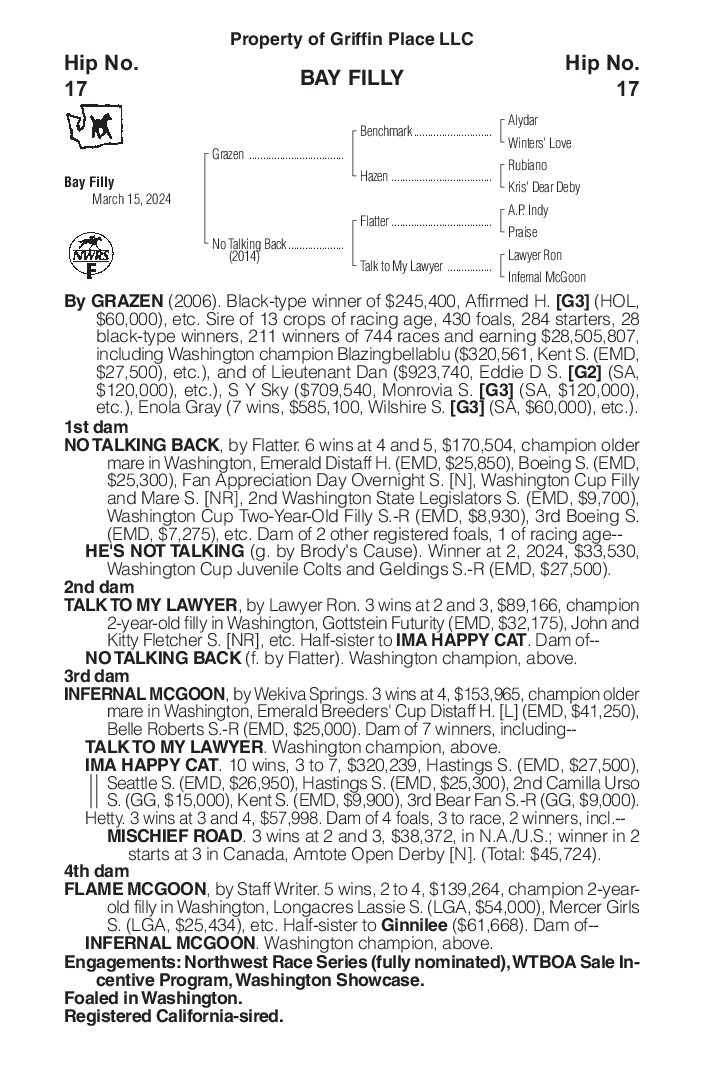
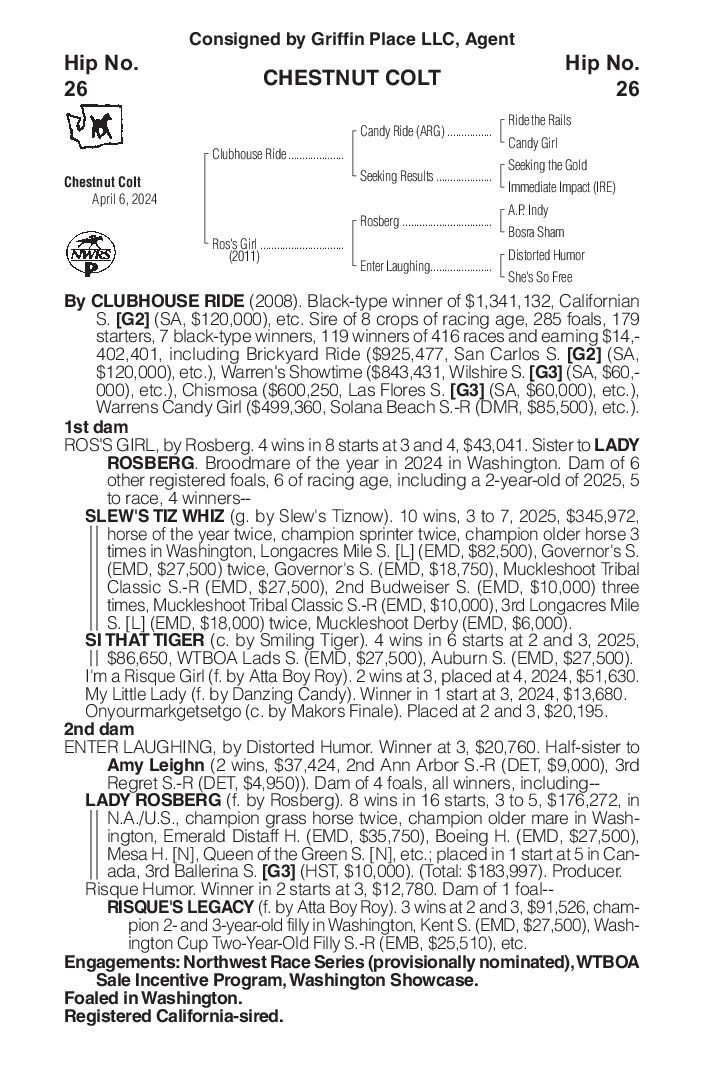
Pedigree guidelines for accepted yearlings
-
The pedigree needs to suggest that the yearling has potential to
run competitively in quality races on major racing circuits.
-
Ideally, the sire would be one of the national or state leaders,
and the dam would have produced several top racehorses.
Not acceptable
-
Yearlings whose dams have produced a number of horses without
producing a very high quality runner.
-
Yearlings by unproven sires who were not top level runners
themselves, and out of only moderate quality mares.
-
Yearlings out of mares whose female families are lacking in
quality black-type runners.
Conformation guidelines
-
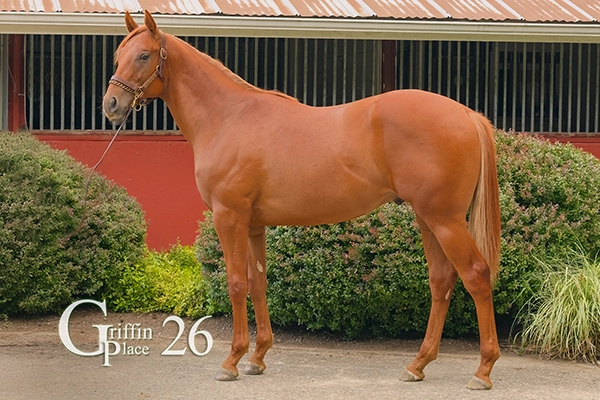
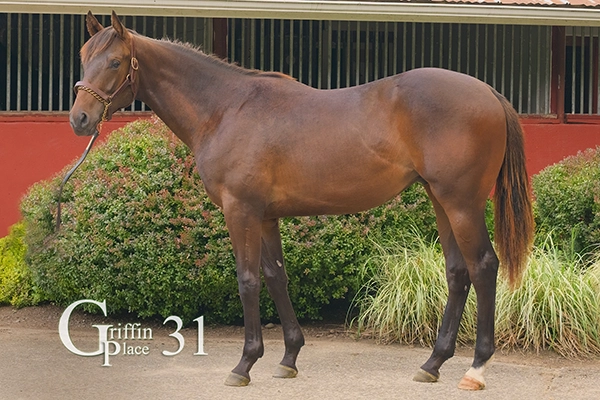
Yearlings should be without major conformation flaws, especially
such serious ones as back at the knee and offset knees. These two
defects generally get worse with time. Any yearling accepted to the
sale, that develops either defect with age, which results in a
severe change in conformation, should be withdrawn from the sale.
-
In addition to generally correct conformation, the big, good
looking, well developed, athletic yearlings are historically sought
by buyers. Small, immature yearlings do not sell well at a summer
sale and are better marketed later in the year.
So, before we enter any of our yearlings, we take a good look and
decide which fit the summer sale, and which would be better off in the
winter sale. I might add that we have had success selling both
places. Sometimes it is better to be a standout in the winter than a
"barely got in" in the summer.
2/26/01
Elttaes Slew by Seattle Slew out of Lady Of
The Mile, owned by Elttaes Stable.We are very pleased with this filly.
She is a nicely balanced very athletic filly with a good attitude.

2/21/01
Nurse Mares.
I received a call today from another breeder who needed a nurse
mare. We have one named "Holly", but she is not in foal this year so,
I couldn't help.
When tragedy strikes and a mare dies, the best thing for the foal
is to find a surrogate mother. We call these "nurse mares". There
are about six professional mares in western Washington that are kept
for this purpose and then rented out when there is a need. They are
selected for ease of "grafting". In other words, they are mares who
readily take foals that are not their own. Often, the daughters of
these mares make good nurse mares too, and they are highly valued.
Believe me, when you need one, you will think that they are worth
their weight in gold when they nicker to your orphan foal.
Sometimes the orphan foal is grafted on to the nurse mare along
with the nurse mare's own foal. This is a tricky graft unless the
nurse mare foals close to the time the orphan is born. We had access
to a nurse mare ready to foal the same day we lost a mare a couple of
years ago. In that case, we captured the allantoic fluid from the
nurse mare, rubbed it all over the orphan, and put the orphan in the
stall before the nurse mare got up. She looked at one and then the
other, and let out a big sigh. She knew. Good old Annie had raised
two together before, so she knew what she was in for. Bless her
heart, she took them both and raised them as her own. Annie is owned
by Blue Ribbon Farm and was awarded a "Lifetime Achievement Award" in
1999 at the WTBA Awards Banquet. She had at that point raised 19
Thoroughbred foals in addition to her own. What a gal!
The other option is to wean the nurse mare's foal and then give her
the orphan, but we don't do this until the nurse mare foal is at least
2 months old. Then the nurse mare foal stays in with the other mares
and foals and they do just fine.
The Washington TB Farm Managers Association has a nurse mare
network coordinated by Debbie Pabst. If anyone in this area has an
orphan foal, or looses a foal and would be willing to let their mare
help an orphan, you may contact Debbie Pabst at (253)-862-9076. She
volunteers her time for this important service.
2/18/01
Today we transfused a foal. Fortunately, we rarely have to
transfuse foals since we have been testing the colostrum.
Foals get all of their initial immunity from the mare's colostrum.
They must ingest this special first milk within hours of birth. We
test the antibody level of each mare's colostrum immediately after
birth using a colostrometer. If the antibody level is low, then we
give the foal donor colostrum, which we have collected from another
previously foaling mare. We routinely collect a small amount of
colostrum from all but maiden mares so that we can use it for just
this situation.
When the foal is about 12 hours old, the veterinarian sees it for
the first time. A blood sample is taken and an IGg test is done.
This tells us if there was adequate passive transfer of immunity. If
there was not, then we immediately give the foal more donor colostrum.
Since there is a narrow window of time that the foal can absorb this
colostrum, if the foal still tests low, then we have no option but to
do a transfusion. Nowadays we use a commercial product that is
derived from plasma from hyper-immune horses and screened for
transmittable disease.
This is a judgement call. We might not have needed to do the
transfusion but when in doubt, we all sleep better if we have done the
best job we can for each foal.
2/13/01
Tommy Teaser.
Tommy is probably the most important horse on the farm. He has
lived here the longest.
Tommy is a teaser. What's that? Well, it probably should be
termed "teasee", but his job is to talk to every mare, every day
during the breeding season. From his reaction to the mare and the
mare's reaction to him, we can determine what the mare's status is.
Is she in estrus? Is she out? Sometimes it's not all that clear, but
Tommy surely is an invaluable aid.
When Tommy thinks the mare is "showing in", we have the
veterinarian ultra sound her ovaries and uterus. We also do a
speculum exam and cytology to make sure there is no infection.
Based on the information the veterinarian gives us, we "book" or
make an appointment with the stallion to breed the mare. Typically,
the veterinarian will do more than one exam to fine tune the exact
time the mare should be bred. After breeding, the mare is examined
again for ovulation. This will tell us if she needs to be bred again,
when to check for pregnancy and whether or not we need to look for
twins. Twins are not good, but I'll leave that discussion for another
day.
Anyway, Tommy LOVES his job. Tommy has been bred to Holly Nurse
Mare and we are hoping that Holly is in foal. Soon we'll know. Tommy
does have several foals around. One is a second-generation teaser and
the rest are 4-H ponies. Did I say that he is actually a large pony?
We think he is Welsh or part Welsh, but we don't care. The mares
respond to him, and that's what's important.

2/11/2001
We're out of here!

2/10/2001
WTBA Annual Awards Dinner see Awards for
Griffin Place results
2/8/01
Washington grows some of the finest timothy and alfalfa in the
world. So high in quality is this forage that it is routinely exported
to breeders in Dubai and Japan. The yearlings demonstrate their
appreciation for Mary Lous' fine quality hay

8/4/01
You'd think these guys had never seen a dog before. Sydney at work!

02/03/2001
This appeared in the Letters to the Editor of the Blood Horse:
"Dear Editor,
Thank you for running a recap online of the speech by the Aga Khan
at the Thoroughbred Breeders Association Awards Dinner in London.
I applaud the Aga Khan for sounding a warning about too many mares
being bred to certain stallions. When shuttle stallions are breeding
300 or more mares a year, and non-shuttle stallions are breeding 150,
even 175 or more, then we have to be very concerned about how these
large books will affect the future of the Thoroughbred.
We already know how it will affect the market. As a small market
breeder, I have always had to choose my matings carefully, but now I
find myself also selecting stallions based on the number of mares in
their book. I can see that unless a yearling is in the top 10% or so
of a stallion's crop based on quality of pedigree and conformation,
the breeders do not have a chance of breaking even. Add to that the
uncertainty of the market and it becomes a real challenge to make a
profit for the mare owner.
I also think a big "thank you" is in order to Seth Hancock of
Claiborne Farm, and farms like his that are holding the line on the
size of their horses' books. I admire Claiborne for its restraint.
I call on The Jockey Club to consider limiting the number of mares
being bred by any one stallion in any one year. The number could be
80, 90, 100, or better yet, 50 or 60. Perhaps this would be judged a
restraint of trade; perhaps it would be judged good husbandry.
However, in the long run, I think it would be best for the breed as
well as best for the breeders.
Mary Lou Griffin"
1/28/01
Two more foals. A filly out of Banchory Jewel by Basket Weave owned
by Tom and Wayne Wenzel (Round Table Racing) foaled 1/26/01 at 1:00PM.
A filly out of No Lost Action by Son Of Briartic owned by Griffin
Place foaled 1/27/01at 7:00PM.
1/1/01
According to the Jockey Club rules, all Thoroughbreds turn one year
older every January 1st. So the weanlings are now yearlings no matter
when they foaled last year.

Always trying to impress the girls, the colts are doing their best
to show off. The rough and tumble play helps foster the competetive
edge needed to be a good racehorse.